

Reimagining theology testing: A glimpse into my classroom
[my first-person imaginative approach to testing Bible knowledge]

□ SEE ALSO

On Tuesday I mentioned in my quick observations on Pope Leo XIV’s first encyclical, Magnifica Humanitas, that I’m in the throes of end-of-term testing and grading. This morning it occurred to me that I can get an entire post out of that, by offering a hopefully entertaining glimpse into how I test my students!
One of my goals as a theology teacher (and, of course, a goal of many teachers of many subjects) is to try to limit, as much as possible, how often I ask for the same information in the same words. It’s hyperbole, but I sometimes tell my students that I will never ask them exactly the same question twice. By testing their knowledge in as many different ways as possible, I get a better idea of what they really understand, and hopefully it stretches their minds in different ways. Hopefully it’s more fun for them; certainly it’s more fun for me.
Not all subjects, of course, are equally amenable to this goal. A math teacher testing specific math skills, or an English teacher testing grammatical skills, can come up with new problems or new sentences ad infinitum. On the other hand, there are limits to how many different ways a history teacher can determine whether students know how long the Great Depression lasted, or who invented the cotton gin.
Teaching moral theology, likewise, I can come up with any number of new illustrations or moral dilemmas to test their understanding of, for example, the cardinal virtues, or the principles of Catholic social teaching. Teaching the Bible, though, I may give a classroom assignment or a quiz with questions like “Which authority sentenced Jesus to death by crucifixion? Which authority had him arrested?” But how do I then check for the same knowledge on a final exam without using basically the same language?
One tool in my toolbox is crafting imaginative first-person comments from the perspective of figures in the Bible, or even from imaginary characters inserted into Bible stories. This approach obliges students to think about the material in different ways, and it helps me assess how much real understanding they have. In some cases, I think it introduces them to a type of imaginative thought that they don’t do much of in any context.
My approach varies from case to case. Sometimes I keep the imaginative element minimal and make the character historically self-aware in a way that makes them easier to identify:
I was an important man in my time—but the unexpected reason my name will live forever is that I pronounced the most notoriously wrong death sentence in history!
My name is _______________, and the man I sentenced to death was ________________.
Other times the imaginative element is more immersive:
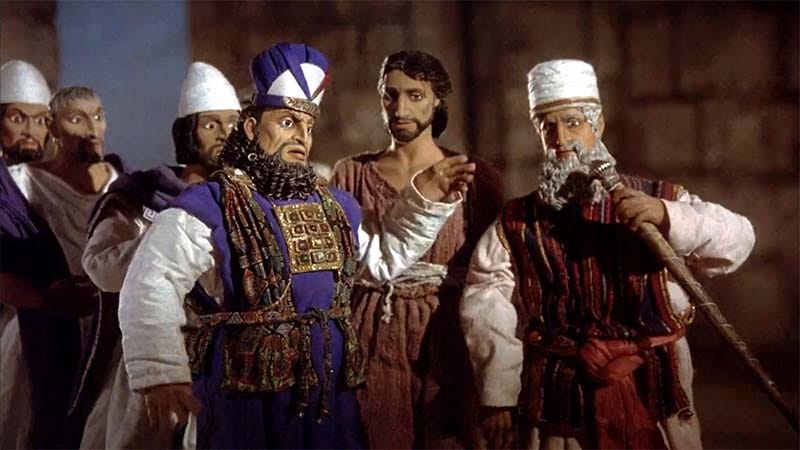
I still don’t know what to think about this prophet from Nazareth! I did agree, after he caused such a disturbance in our Temple, that we had to do something. But was it right for us to have him arrested? Was it right that the Romans executed him? I’m not sure I will ever have the answers.
I am a member of the ________________ in the city of ________________.
These examples, of course, recapitulate the sample questions I asked earlier. I particularly enjoy exploring the mindset of Israel’s enemies in immersive scenarios like these:
What is happening to our once-great nation? This family of foreigners fills our land, threatening to overwhelm us—there are too many of them! We must crush them before they crush us. Force them without mercy to work for us. If that’s not enough, kill their sons! Let them call on their God all they like—we have gods and magic too. What kind of ruler would I be if my heart feared such things?
I am called ________________, and I rule the land of ________________.
I’m a soldier of a mighty people! I was proud to march with our armies against the royal city of our enemies. They boasted about their one God and their long line of great kings—but Marduk, god of the sun, gave us the victory! We conquered their city and burned their God’s holy house. Then, as our enemies wept in defeat, we triumphantly led them in chains back to our land. Marduk is great!
My people are the ________________!
Here are some more. How many can you identify?
I was in shock when all my brothers turned against me—but I get it! When a father has favorites, it’s hard for brothers to deal with. I thought I couldn’t have been brought any lower—but then God raised me up high and used it for everyone’s good, and when I met my brothers again I forgave them.
My name is ________________, and my father is ________________.
Of the two of us, my brother was a better man than me. He knew it, I knew it—and, after we made offerings to God, I knew that God knew it. My jealousy made me blind with rage … and now, God forgive me, my brother is dead. Such a thing never happened before!
My name is ________________, and my brother was ________________.
Long before any priestly tribe or anointed dynasty, I was king of Salem and priest of God Most High. How and why, God knows! Centuries after my time, another king took inspiration from me. He made my city his own capital, and, though he was not a priest, he tried to be. God’s hand was in this—and his son went further than he did. The greatest of his descendants would go further still!
My name is ________________, and the later king I inspired was ________________.
His greatest descendant was ________________.
God called his people to be a kingdom of priests—but after they committed a great sin, that was never going to happen. Instead, God unexpectedly called me to a special role. It was hard for me to understand, but when my brother came to me and poured oil on my head, I knew my life would never be the same.
My name is ________________, and my brother is ________________.
You can’t begin to imagine how good it was before! A perfect world, all in harmony with God and everything else. The man and I knew what God commanded—but we listened to a lying voice and disobeyed. Now everything is changed forever for everyone.
My name is ________________, and we listened to ________________.
As a devout, highly-trained follower of the Jewish religion, I was sure I knew what God wanted—and it certainly wasn’t a radical new group devoted to a failed king executed as a criminal! I worked hard to stamp out this misguided group. We even put one of them to death. But then something happened that changed my life—and world history—forever. I experienced God in a new way…the last way I was expecting. Now I’m ready to die for what I was once ready to kill for!1
My name is ________________. The person who was killed was ________________.
These two historically self-aware cases are a little different—extra credit if you know these!
I was a Jewish scholar of history, and I wrote about my people’s struggles and wars, especially with Rome. Some Jews, and some Gentiles too, have embraced a new teaching about a man they believe was God’s chosen one. I am not a follower of this way, but I did mention that man and his followers, including his brother James, a leader of the movement. Long after my time, my historical account became important to scholars studying this man, precisely because I wasn’t one of his followers.
My name is ________________.
I was a Roman scholar of history. Among many other things, I wrote about the emperor Nero’s brutal persecution of Christians, whom I considered a disgraceful, superstitious group. In my writings I mentioned that these people followed Christ, whom one of our local officials, Pontius Pilate, had put to death. Long after my time, my historical account became important to scholars studying this man, precisely because I wasn’t a Christian.
My name is ________________.
Class is over! Enjoy the summer!
□ SEE ALSO
Confirmation: What exactly is it for?

Here’s something I’ve long told Confirmation students in CCD. It’s far from a complete theology of either sacrament, obviously, but it’s meant to clarify, in simple, intuitive terms, how Baptism and Confirmation are complementary without making Baptism seem incomplete or Confirmation redundant.
The text of question 10 is updated—I inadvertently initially published this post with the text of this question incomplete. Apologies!
Here’s the answer key, for those who have requested it. (Many commenters have gotten all or most of the answers right.)
1. Pontius Pilate; Jesus
2. Sanhedrin; Jerusalem
3. Pharaoh; Egypt
4. Babylonians
5. Joseph; Jacob/Israel
6. Cain; Abel
7. Melchizedek; King David; Jesus
8. Aaron; Moses
9. Eve; the snake (or Satan, but I prefer the snake as the best answer)
10. Paul of Tarsus; Stephen
EC1. Flavius Josephus
EC2. Tacitus
I enjoyed this! Very creative, and I am pretty sure I got them all, although iffy on the second extra credit question.
And #10... did it get accidentally abbreviated? I have a guess based on what's there, but it looks like some of it may be missing.
Anyway, good work! Lots of fun