

Inside ‘Hand to Hand’
[Back story, interpretive notes, and a teacher who changed my life—and my appreciation of my own work]

□ RELATED

NOTE: Before reading the post below, please read the one above first.
For those who may be interested, I offer the following background and interpretive notes on Hand to Hand. I also have a story to share about a teacher who changed my life more than either of us could have expected, and how he forever changed how I see this particular work of mine.
The idea for Hand to Hand started in 1989 with a collaboration with a fellow cartooning student at the School of Visual Arts, a friend and brother in Christ named Joe. Joe was invited to create a piece for an anthology minicomic explicitly as a response or companion piece to a dark, subversive piece called, I believe, “Christendom,” a six-panel collage of what I recall as grim medieval images with captions like “Baptism” and “Confession.” The editor, though not a Christian, thought it would be interesting to pair this negative piece with a piece by a Christian cartooning student.
Joe chose the title “Mere Christendom,” and we brainstormed how to present the Christian story in just six panels. We picked captions like “Creation,” “Fall,” “Crucifixion,” etc. Then, starting with the notion of evoking “Creation” with a quotation from Michelangelo’s Creation of Adam, I hit on the idea of doing the whole piece focusing on hands, which Joe happily embraced and executed.1
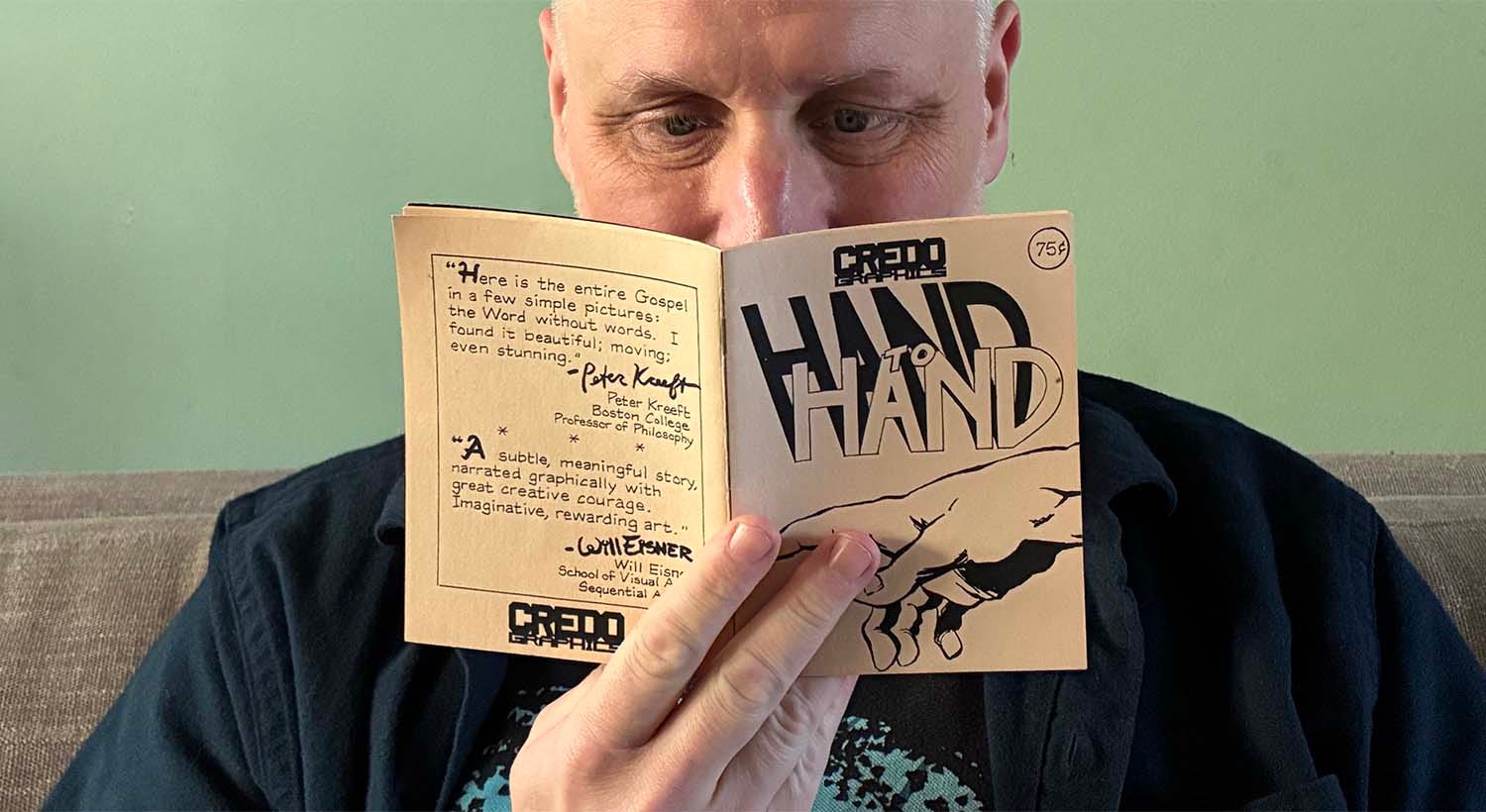
The idea stuck in my head, and, for my final project for Will Eisner’s Sequential Art class, I set out to do a true narrative interpretation of the concept in a 16-page minicomic.
I believed, then as now, that creativity thrives under constraint, so I set myself some restrictions.
Going further than “Mere Christendom,” I determined that I would use no captions: no text of any kind. The images alone would carry the narrative. (“The Word without words,” as Peter Kreeft would later write in his kind blurb.2)
I also decided to strip the images, as much as possible, of any representational imagery except hands. (For example, in “Mere Christendom,” we may have depicted the Incarnation with a baby’s hand extending from a wooden manger. I eliminated the manger and depicted the Incarnation metaphorically, with the hand of God coming down and entering the created world, symbolized by the panel border.) However, I ultimately had to allow a single exception: I couldn’t depict the crucifixion without including part of the cross and a nail (on pages 6 and 7).3
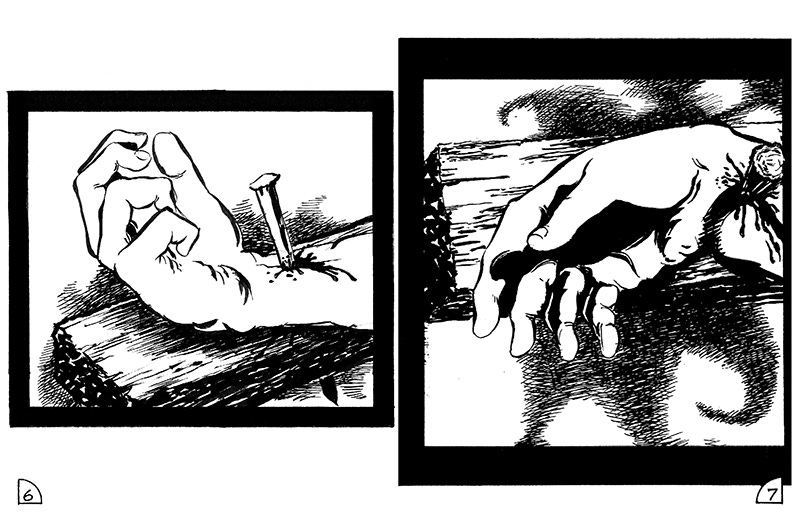
I wanted the opening quotation from Michelangelo to be as direct as possible (granted the inherent limitations of my comic-book brush-and-pen milieu). This meant accepting a burden of anatomical realism on the other images—one that I would not fully succeed in executing.
It also meant that God would always be represented as the right hand, and Adam/humanity as the left hand.4
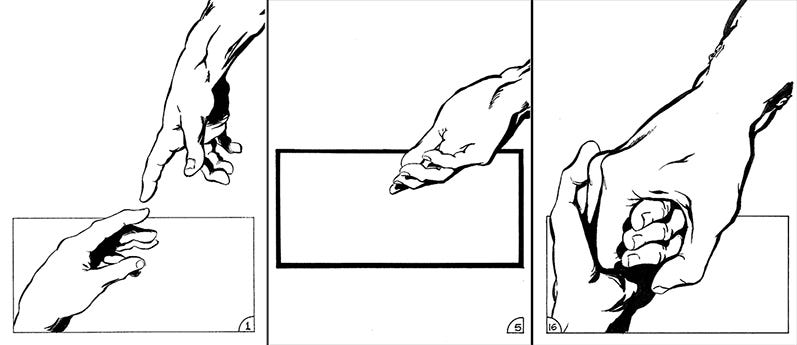
As noted above, the panel border came to represent the created world, the natural order, or finitude. Thus, the Creator’s hand comes from unbounded space, while the human hand comes from within the panel. For example:
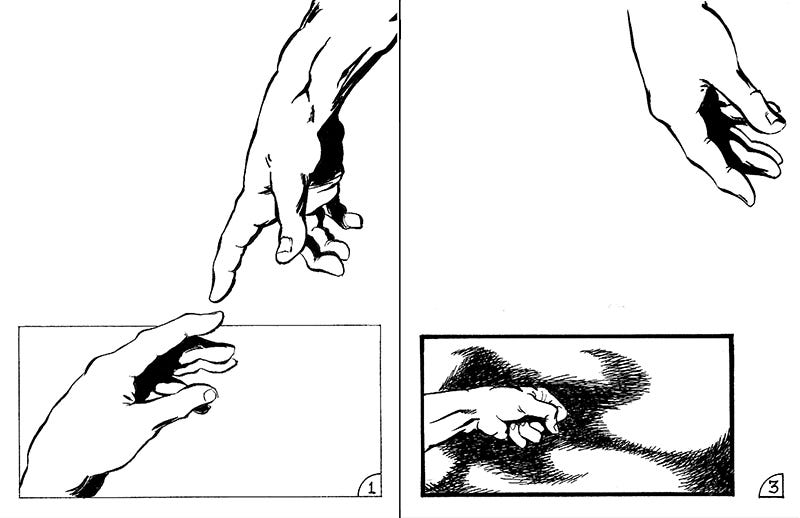
On page 1, God, imparting the spark of divine life to Adam in Michelangelo’s composition, calls humanity to rise above the order of nature into the realm of grace. (Adam’s finger slightly protrudes beyond the panel border. This was also, of course, an aesthetic choice, as I didn’t want to run the panel border between the two fingers!)
On page 5, God enters into the world of creation, representing the Incarnation.
On page 16, both hands cross the boundary between finitude and the infinite.
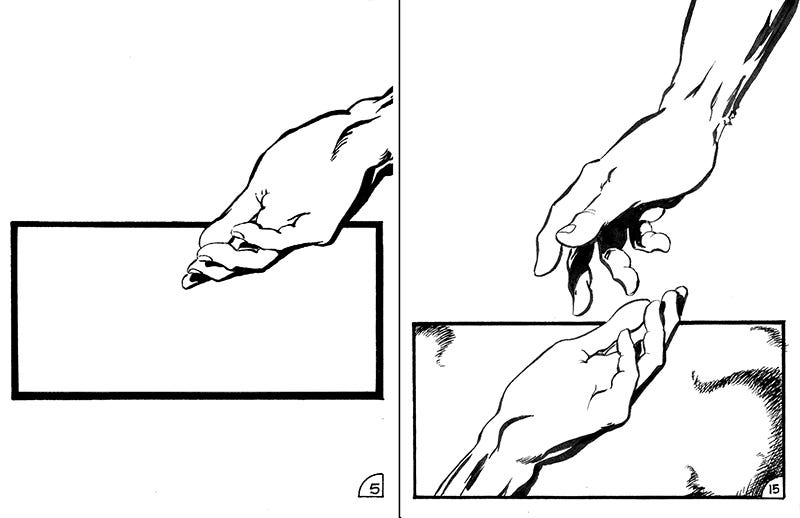
The key creative breakthrough occurred during the planning stages, when I realized that some of the hand positions that suggested themselves resembled one another—not surprisingly, since there are only so many clearly meaningful ways that a hand can be disposed.5 The obvious thing to do was to lean into these resemblances, making similar hands as much the same as possible—in effect, quoting myself—thereby creating resonances and layered meanings.
Perhaps most obviously and significantly, on page 5, I represented the Incarnation by turning the hand of God palm upward in a serving, surrendering, giving gesture—and it struck me that the same gesture (flipped, of course) could also express the receptivity to God of redeemed humanity on page 15. Thus, God taking to himself our humanity in service to his creatures enables us to serve him in return. The right hand in the first image and the left hand in the second are virtually identical.
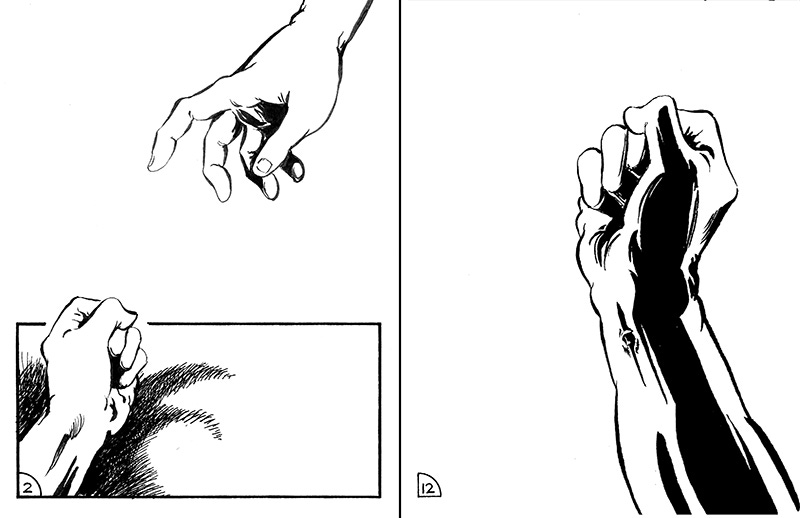
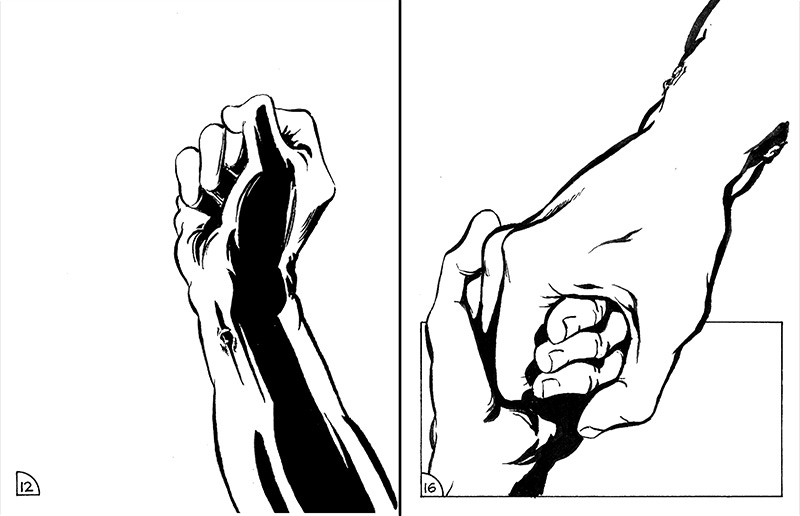
Conversely, the hand of Adam/humanity becoming a fist raised in rebellion as a representation of the original sin (page 2) corresponds to the resurrected Christ raising his fist in triumph over Death, the last enemy (page 12). The rendering here is very different, but the poses are identical.
I like to think that my boldest and perhaps most inspired move was repurposing Michelangelo’s iconically limp, passive hand of Adam—a maximum contrast to the dynamic hand of the Creator—two pages later as the hand of God, where the passivity expresses divine grief at humanity’s fall into sin and death.
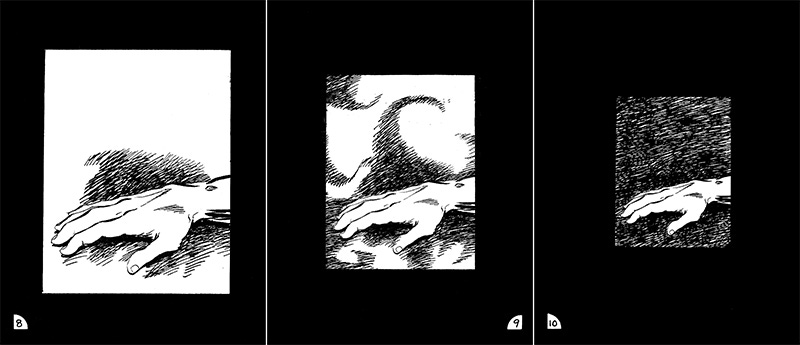
The most narratively significant reuse of an image is, of course, the dead hand of Christ, seen three times on pages 8–10, representing the three days in the tomb. (The hand also recedes as the darkness grows, perhaps suggesting the deepening grief and despair of Jesus’ disciples.)
And, of course, a dead hand is a dead hand; Christ takes our death upon himself.
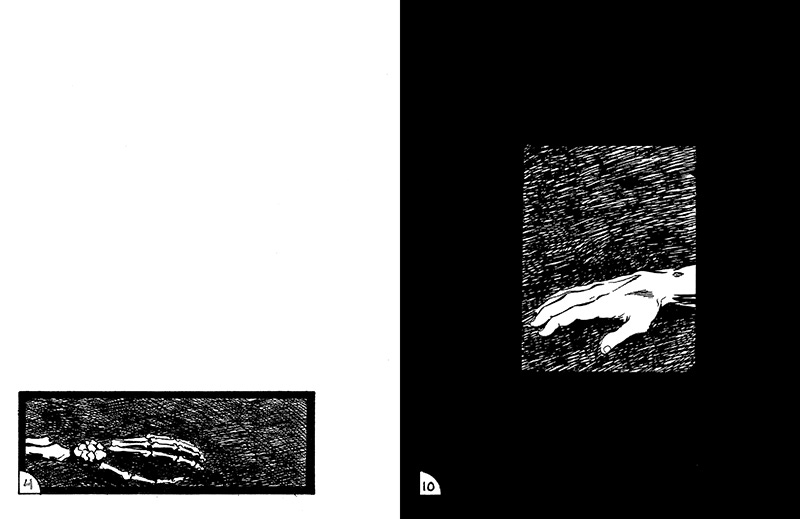
The cross-hatching in the above images, representing sin or death or both, runs through the work from the second page to the penultimate one. Starting on page 2, the cross-hatching grows and spreads, first around the rebellious, doomed fist of Adam/humanity, and then around the crucified and slain hand of Christ. But it retreats before the resurrection (pages 11 and 12) and dissipates around the hand of humanity reborn (page 14). Like the panel borders, the cross-hatching is a nonrepresentational technique (although on page 10 it could represent the darkness of the tomb).
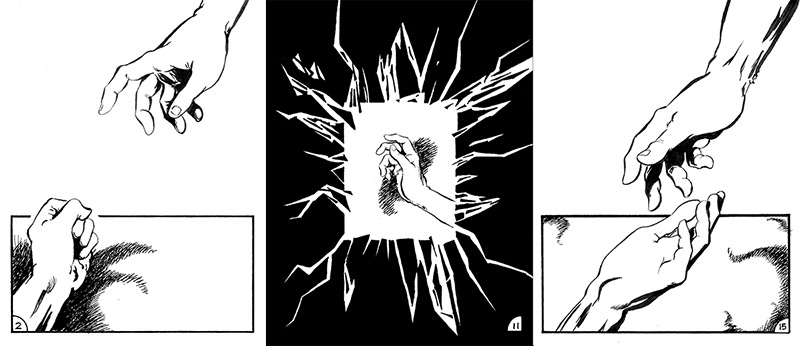
Are there other matching hands? The hand of God in the three images below—recoiling from Adam’s rebellion (page 2), rising from death (page 11), and moving to clasp the hand of humanity (page 15)—are similar, but not exact matches; in fact, the vibe of the hands on pages 2 and 15 are diametrically opposed). In my artist’s note 36 years ago, I claimed that while there are 23 depictions of hands in these 16 pages, there are only “11 separate positions.” Recounting now, though, I can’t make it less than 13!6
The image that, artistically, I’m most pleased with is Christ’s fist raised in triumph on page 12.7 (I remember a fellow cartooning student, who often offered feedback on my work, appreciatively saying, “This looks every bit as triumphant as you wanted it to.”) The dramatic tenebrist shadowing in this image, creating an impression of bright light, reflects countless hours immersed in Frank Miller’s and Klaus Jansen’s work on Daredevil.
The image that I most wish I had worked harder to get right is, alas, the final image of the clasped hands. The emotion is there (the decision to zoom in was the right call), but the positioning and interaction of the fingers is not entirely convincing.
That’s all I have to say about my creative process. I want to close with a story about a teacher whose response to Hand to Hand has forever shaped my own appreciation of this work.
A tribute to a teacher
Robert Milgrom changed my life more than either of us could have guessed when I was his student at SVA.

Bob headed the Humanities department. I took two courses with him, Medieval Literature and Arthurian Literature, and I found his classes by far the most intellectually stimulating of all my studies. Other courses were more relevant to me academically and in my future life, and yet I remember Bob’s classes better than any of my other studies at SVA. I remember his teaching style, his engagement with me and the other students. I remember things he said to me, notes he wrote on my papers.
He was one of only two SVA professors with whom I had any kind of personal interaction after graduating (the other being my film history teacher, Gene Stavis). In 1992, when I was applying for a Master’s program at St. Charles Borromeo Seminary, Bob wrote a glowing letter of recommendation. Getting into that program has changed my life to this day more than any course I took at SVA, so my debt to him is incalculable. We reconnected on Facebook in 2018, when he had only a couple of months to live.
I couldn’t tell you a single thing that anyone else wrote in my college yearbook—but I never forgot Bob’s inscription. When he handed my yearbook back to me and I read what he wrote, it instantly brought me back to The Canterbury Tales and Bob’s discussion of Chaucer’s introduction to the Clerk (or Scholar) of Oxenford. The Clerk was Bob’s favorite character among the pilgrims, and Bob relished Chaucer’s affection for him and the lack of any critical or satirical edge to his characterization. So I was deeply touched to recognize Bob’s allusion to Chaucer in his inscription:
“For Steve, a true student in mind and spirit —
‘Gladly would he learn, and gladly teach.’ Best, Bob M.”
To whatever words of surprised appreciation I blurted on reading this, he said, in his raspy smoker’s voice, “It comes from the heart, Steve.”
After Bob died, his widow contacted me and told me that he would have wanted me to have some of his books on medieval literature, particularly those dealing with medieval Catholicism and Arthurian literature. Reading those books, with his handwritten notes in the margins, was like revisiting his class. It helped to prepare me to write my epic 10,000-word essay on David Lowery’s 2021 film The Green Knight for Bright Wall/Dark Room.
Bob was not a believer, but he understood the medieval mind so well that things he said in class turned on light bulbs in my mind regarding medieval Christian thought. In some small way he probably played a role in my conversion to Catholicism.
Although I didn’t have a class with Bob in my senior year, I sought him out and showed him Hand to Hand.
He paged through it slowly and carefully, commenting on the theological implications of each page, with (of course) eager additional commentary from me, the proud young artist. Bob winced at the crucifixion, and admired the triumphant raised fist of the resurrected Christ (“Christus victor!”).
Then he turned his attention to page 13—and at first he read it in a way I hadn’t intended or anticipated.
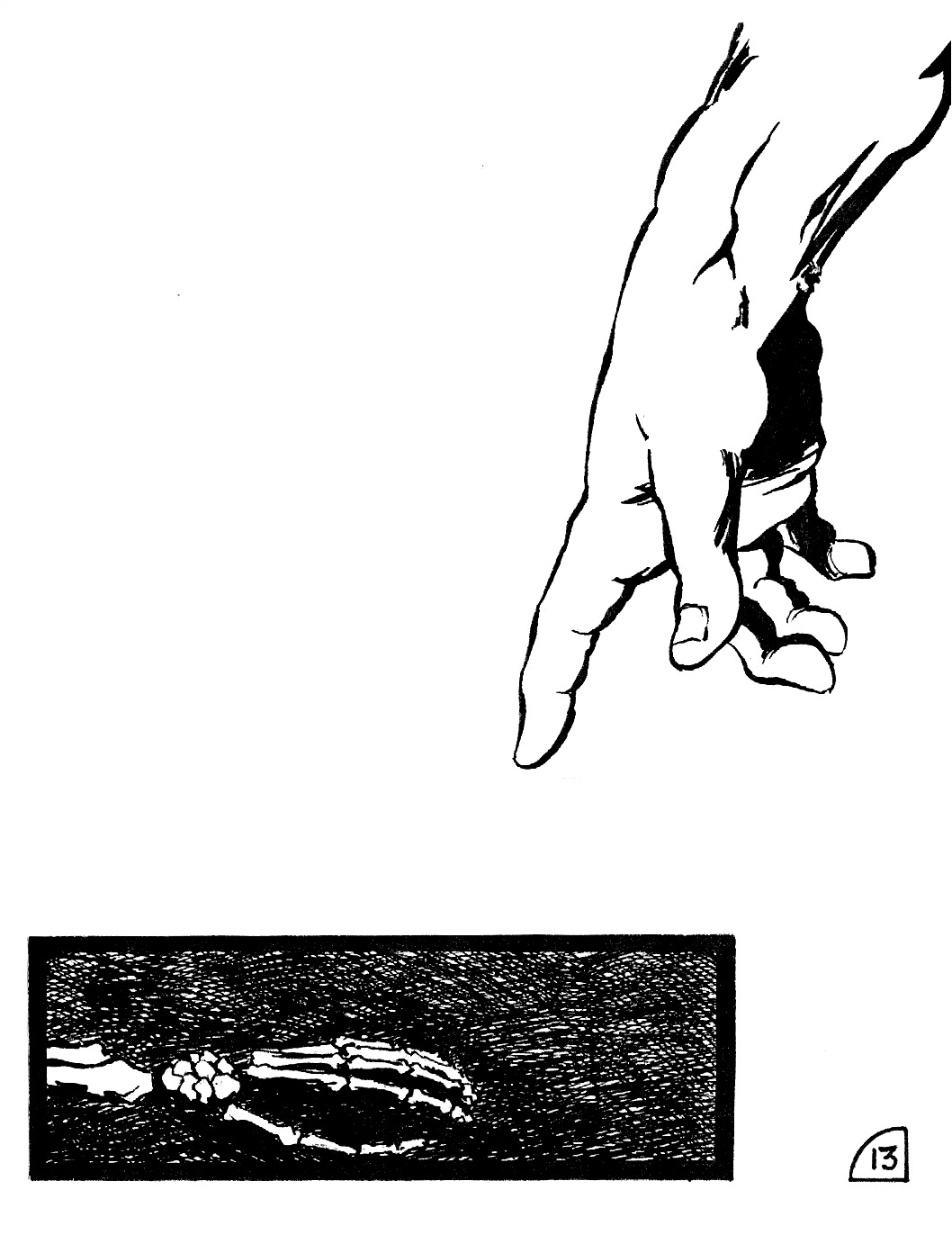
“This looks like judgment!” he exclaimed, in a stentorian tone he used in class when commenting on the sterner side of human beliefs and experiences. It wasn’t a disapproving tone, but there was a professorial objectivity behind it, suggesting an emotional distance from the matter at hand.
This was unexpected—and momentarily disconcerting. I said nothing, holding my breath as he turned the page and took in pages 14 and 15.
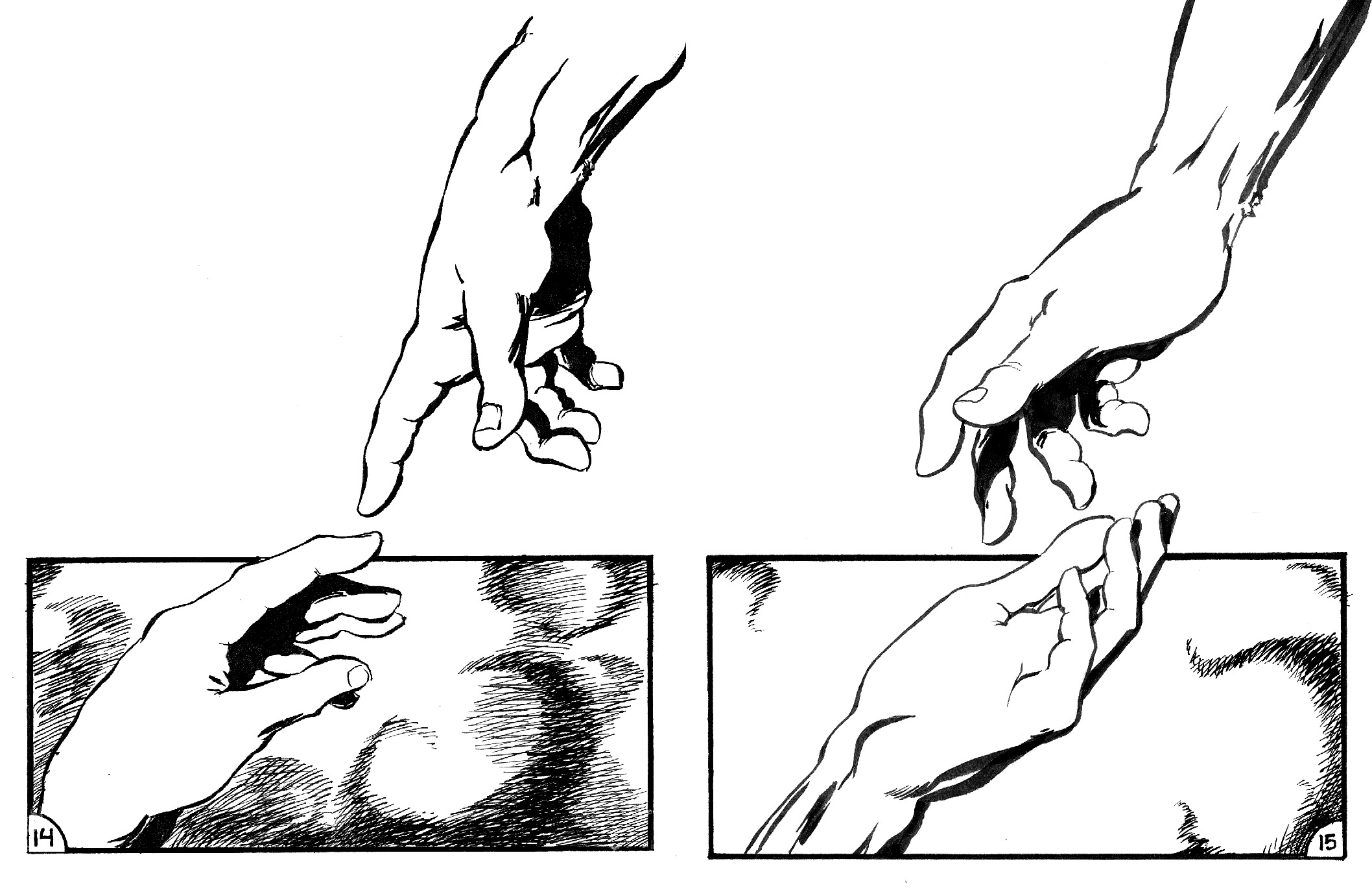
At once his eyes softened and a great smile spread across his face. “Oh, Steve,” he said, and the emotional distance was gone. He turned the page to take in the final image of clasped hands, and the smile grew broader. After a moment, he said simply, “Wonderful.”
Bob’s response to Hand to Hand has become definitive for me: I can’t think of the work without thinking of him. As a writer, I have found that I sometimes write a piece with a particular potential or hypothetical reader in mind (for example, I’ve written many film reviews in imaginary dialogue with a certain reader, or perhaps another critic). Hand to Hand was not made with any reader in mind—but when I think of it today, it’s as if I made that book for Bob, especially for his reaction to the last four images. That reaction matters far more to me even than my prized blurbs from Eisner and Kreeft. (And, of course, it prompts me to pray for his soul.)
Now I appreciate the image on page 13 in a new, more dramatic way: What does the crucified Creator’s hand betoken? Does judgment or mercy await on the next page? Page 14 is then a reveal, rather than simply what comes next. That hadn’t been my intention when I created it, but that’s how I see it today, thanks to Bob.
□ SEE ALSO
‘Hand to Hand’: Genesis to Revelation in 16 simple images

Happy Easter Week! For many years, Suzanne, RN has been urging me to digitize Hand to Hand and share it online. Last summer I finally dug up the original artwork and had scans made—but I’ve been waiting till Easter to share it. 36 years after its creation, here it is. I hope you enjoy it!
My Easter cartoon: Death’s bad day

The theme of this comic, of course, is the defeat of death in the resurrection of Jesus—the conceit being Death personified as a battered, tattered Grim Reaper with his scythe cracked over his skull. This is naturally a terrible shock to Satan: seeing his virtually invincible right-hand man utterly defeated by Christus Victor, Christ the victorious champion.
For a long time I had a copy of this anthology minicomic with the two pieces side by side, but very unhappily it seems I no longer do. I don’t even recall the name of the minicomic: only the label, Worm Systems.
I am pleased to say that, 34 years later, I had the opportunity to make some repayment of Kreeft’s kindness in blurbing Hand to Hand: I blurbed a book of his, God on Stage: 15 Plays that Ask the Big Questions, published in 2024 by Word on Fire. (If you scroll down, you can read my blurb on the Word on Fire website.)
Incidentally, this was the second book that I blurbed for Word on Fire (after Popcorn With the Pope: A Guide to the Vatican Film List, on which I also offered some fact checking, corrections, and other notes). I don’t expect they will ask me to blurb anything else any time soon.
It was because of this single exception that I wrote in the “Word From the Artist” that Hand to Hand attempts to tell the story of salvation history “using almost nothing but hands.”
On a side note, I depicted the nails going through Jesus’ wrists, in keeping with the common wisdom that nails through the palms would not support the weight of a body. I have since learned that while this idea is widely accepted, a minority view argues that a nail through the right part of the hand is capable of supporting the body’s weight. We do have archaeological evidence of nails being used in crucifixion—three cases of skeletal remains buried with a nail still in the heel bone, found in Roman-era cemeteries in Israel (1968), Italy (2018), and most recently England (2021)—but only with nails in the heel bones; so far we have no archaeological evidence where nails may have been driven to transfix the upper limbs.
This is a correction; I originally wrote the opposite. I mix up left and right all the time!
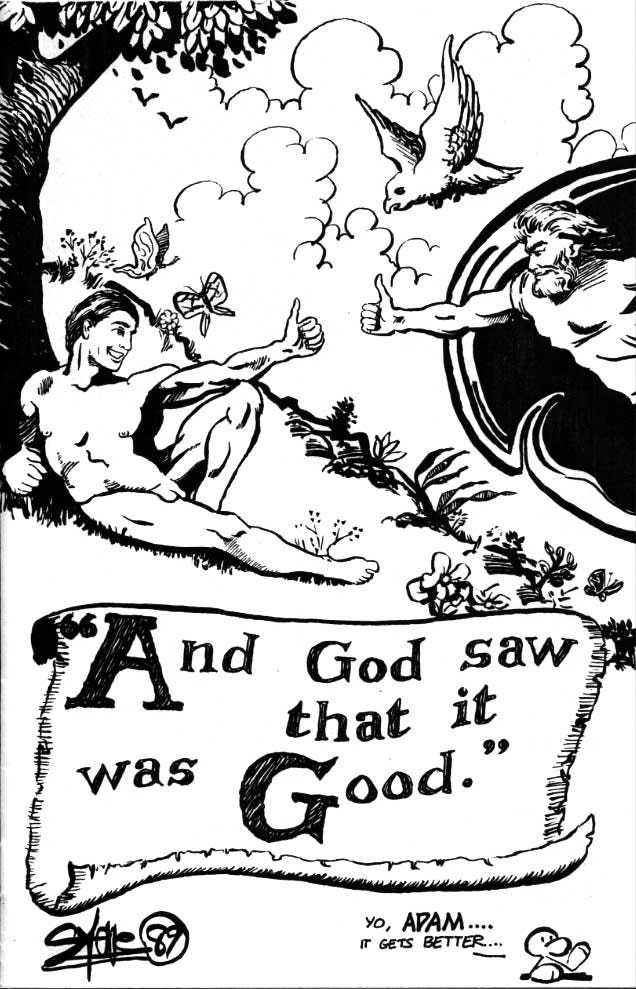
I also wasn’t about to introduce comic or ironic gestures into this work—though I had done this in the past! Hand to Hand was my second riff on Michelangelo’s Creation of Adam; here, from an anthology minicomic of my own the previous year, is the first:
Perhaps on page 14, where God calls humanity from death to life, instead of directly repeating both hands from the opening quotation from Michelangelo, I should have repeated the page 11 pose for Christ’s resurrection.
As I’ve noted before, the triumph of good over evil is a running motif in my work.
So much can be said with only hands.
I didn’t want to defile your comic by saying anything more than what I did, so I’ll say it here:
Are you familiar with Barry Moser? The 1990 edition of Strange Case of Dr. Jekyll and Mr. Hyde features illustrations by him. It’s one of my favorite books, and that’s my favorite edition: Barry Moser seems to have really “gotten” the story that Robert Louis Stevenson was telling (apart from the many adaptations, references, and parodies we all know now).
Two of the illustrations are the hand of Dr. Henry Jekyll, and the hand of Mr. Edward Hyde. We don’t see them together in the same illustration, which is appropriate, but the two illustrations contrast each other nicely. Better still, Hyde’s hand is all we ever see of him, as per the text.
One more thing: did you mix up left and right in this article? God’s hand is the right hand, and Adam’s is the left.
I love this!
Though it may say something about my darker temperament, that I can imagine an alternate panel 10, inspired by Hobein's image of the corpse of Christ that so disturbed Dostoevsky to nearly destroy his faith.
But I do like the zooming-out-on-the-same-hand effect.