

Schrödinger’s Mitch?
[Can McConnell be alive and dead at the same time? In Trump’s America, perhaps.]

□ SEE ALSO


This one is somewhat outside my usual sphere of interest, at least materially. Humanly speaking, Mitch McConnell’s current status is objectively more important than reporting about him; as an American concerned about public access to truth, I’m more interested in the reporting.
A basic facet of life in our day is President Trump’s well-established pattern of creating his own reality as he goes and refusing to acknowledge or bow to any facts that he doesn’t like: what I’ve called his forever war on reality. It’s a facet of life the news media has been largely unable or unwilling to confront in any effective, consistent way. Yesterday The Bulwark’s Jonathan V. Last argued that the corporate media has essentially surrendered to Trump.
Trumpism is larger than Trump himself. Brazening out lies and public pressure is increasingly seen as a viable strategy. More than six weeks after Kentucky GOP Senator Mitch McConnell’s June 14 medical episode and disappearance from public view, it’s unclear just how brazen his team and supporters are being in their handling of his situation.
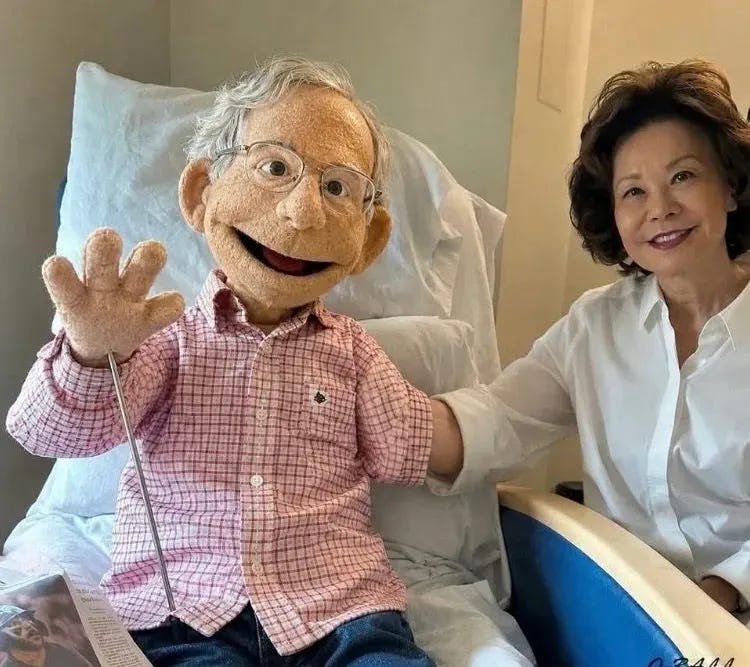
On July 12, almost a month after McConnell’s disappearance, his office broke the near-total silence on his condition, releasing what amounts to an apparent proof-of-life photo and a statement ostensibly from McConnell. In the photo, McConnell is sitting quite upright next to his wife, Elaine Chao. He is dressed in jeans and a checked shirt, and he’s casually holding a current newspaper, subtly establishing the time frame. The photo has survived considerable expert analysis; there appears to be no evidence that it is fake or doctored.1

Reportage on this event took the claims at face value. Although journalists had no direct contact with McConnell, the information was reported as coming directly from the senator himself. Here’s a typical example, from NPR:
McConnell says a fall led to his hospitalization, breaking weeks of silence
Sen. Mitch McConnell on Sunday revealed for the first time that a fall led to his hospitalization, breaking the silence about his condition after weeks of mounting speculation about the Kentucky Republican’s health.
McConnell, 84, said in a statement that he was “briefly unconscious” around the time he was first taken to the hospital and has undergone a battery of tests to try and determine what led to his fall. He said he was also treated for mild pneumonia and has been moved to a rehabilitation facility.
“My doctors have confirmed that I didn’t break any bones or suffer a concussion. I didn’t have a heart attack or a stroke. I don’t have any tumors or hemorrhages,” McConnell said, adding that he is now “regaining my strength.”
Under ordinary circumstances, this journalistic approach would be appropriate. But the circumstances are far from ordinary. It simply cannot be reasonably assumed that McConnell’s condition is as reported and that the messages ostensibly from him are in fact. His status might be compared to Schrödinger’s cat: both alive and dead at the same time. Is this possible? In Trump’s America, perhaps.
The following details have all been widely reported, but I’ve seen no single source bring them all together.2
According to emergency dispatch audio leaked in early July by independent journalist Desiree Townsend, first responders on June 14 found McConnell unconscious, in cardiac arrest, and administered CPR. CPR is a big deal. The chances of survival for a patient of McConnell’s age found in cardiac arrest and given CPR are poor (less than 10 percent). In this age group, even if the patient revives, broken ribs and sternal fractures from the procedure are more common than not.
Video from the scene, shot by a neighbor and shared with CNN, shows responders loading a patient identified by witnesses as McConnell on a stretcher into the ambulance. Witnesses said that there was no oxygen mask, no evident sign of urgency, and no siren on departure. This suggests either that the patient was stable and there were no concerns, or that the patient was dead. An octogenerian senator who had just experienced cardiac arrest, received CPR on the spot, and been revived would not be a low-concern patient.
Trump insider and conspiracy theorist Laura Loomer claimed early on that a “high level source” told her that McConnell was “officially brain dead”—and Townsend (who first reported the dispatch audio) said that her sources had been telling her the same “for days.” This is prima facie low-grade information; perhaps more concerningly, Democratic Kentucky governor Andy Beshear claimed to have received information from two unidentified non-state “agencies” “suggesting” that McConnell had died. Beshear has called on McConnell to provide his constituents with direct evidence of his capacity to serve or to resign. A number of GOP figures (Josh Hawley, Steve Bannon) as well as Democrats have called on McConnell to be more transparent about his condition and prognosis and to indicate when he may be able to resume his duties or to step aside.
Despite these questions and concerns, it took nearly a month before his office released the July 12 statement and the photo. In the statement, McConnell purportly states that he was “briefly unconscious” due to a fall, and was now in a rehabilitation center after being released from the hospital. What hospital and what rehabilitation center? No one knows! It’s not easy to imagine such a thing being kept an absolute secret for so long.
The statement also included comments ostensibly from Congress’s Office of the Attending Physician (OAP) stating that McConnell had sustained “minor injuries” and was undergoing “intensive physical therapy.” According to the OAP comments, “A comprehensive evaluation by a multidisciplinary team determined that he had no fractures, cardiac abnormalities, stroke, tumor, or hemorrhage.” Why exactly such “minor injuries” would require such a prolonged, intensive rehabilitation is unclear.
At least four allies (three Republican colleagues and conservative commentator Scott Jennings) claim to have spoken to McConnell on the phone, in three cases specifying “for about 20 minutes.” A man in McConnell’s apparent condition, able to hold 20-minute conversations with colleagues, could presumably give a phoner interview to a journalist, or at least respond to concerns about his condition and criticism of his silence with a video or audio recording. (Several media outlets have asked to interview McConnell, to no avail.) Alternatively, he could authorize the facility that he is in to confirm his condition. None of this has happened.
Instead, on Monday, his office released … a second proof-of-life photo remarkably similar to the first, but without a clue as to the date, like the newspaper in the first photo.

The laid-back response from Team Mitch to widespread questions, challenges, rumors, and conspiracy theories belies a looming deadline: If McConnell’s seat is declared vacant by August 3, it will trigger a special election to replace him. If McConnell is deemed to be theoretically occupying the seat through Sunday, the seat will sit vacant until the scheduled election—perhaps the outcome preferred by congressional Republicans. Governor Beshear has just issued an “ultimatum” to McConnell to address Kentuckians or resign, but the clock has almost run out.
I don’t pretend to know the truth of McConnell’s condition. What I think I can say is that the cynical indifference of Team Mitch to the consternation and public pressure around their man’s disappearance almost two months before the special election deadline looks like a level of shameless Machiavellian will to power and indifference to appearances that Trump has established as thinkable in U.S. politics.3 Certainly, if McConnell’s condition is graver that we have been told, the people around him must know the secret will come out. That’s a concern that meant more in the past than it does today.
By accepting the statements of McConnell’s office at face value, the news media are effectively enabling what looks like an unprincipled, cynical power grab. What is so hard about using language like “McConnell’s office says a fall led to his hospitalization” or “McConnell, 84, reportedly said in a statement that he was ‘briefly unconscious’”, etc? It’s a little longer, I realize. But the extra length never prevents news outlets from scrupulously describing the president as “baselessly claiming” something rather than “lying,” or what video showed people “appearing to” do. Perhaps they’re more concerned about avoiding lawsuits than about misleading the public.
People close to McConnell have probably known at least for weeks that he would not be returning to represent his constituents, who have a legal right to pick someone to represent them in his absence. Team Mitch appears to be trying to deny them that right. Whatever McConnell’s condition, it’s a scenario that would have been difficult to imagine, if not 10 years ago,4 at least 15 or 20.
□ SEE ALSO
American unreality under Trump: Notes on the state of the Union at 250 years

A patriotic visitor to our nation’s capital on July 4, 2026 might have been struck by images suggestive of a nation in decline. Compared to the worst things happening in our country, these are trivial, even symbolic—but symbolism matters.
The lack of evidence of photographic fakery has not, of course, stopped amateur investigators, late-night comics, and Internet memers from having their say.
As always, comments, corrections, and additions are welcome.
Woodrow Wilson’s incapacitating stroke was hidden from the public and even from members of his cabinet, and his wife became so essential to managing his administration that she has been called a “secret president.” That was in a very different information ecosystem, at a time when it was possible to keep secrets like that; it was also before the 25th Amendment, and there was no clear Constitutional path of action in any case. The very different case of Franklin D. Roosevelt, who was mentally sharp but whose partial paralysis from polio was largely kept secret, also bespeaks an earlier information ecosystem.
Much more recently, the public was kept in the dark about the cognitive declines of both Ronald Reagan and Joe Biden, but they at least were able to show up for work, and their teams may have believed that their situations could be managed. Then there’s Trump, who is manifestly degenerating before our eyes—hardly a major concern for him at this advanced stage in his forever war on reality.
I originally wrote “ten years,” but something was bugging me that that wasn’t long enough. Reader Joshua Wilson put his finger on it in the comments: McConnell himself, exactly ten years ago, blocking judicial appointments (including to the Supreme Court) until after an election was “a move from the exact same playbook.” (Not exactly the same, but similar in spirit.)
If he actually had CPR there is zero chance that the picture is real. There would be very little chance he would even survive, and if he did he wouldn't be looking like that picture. If he had CPR why no rush when he was taken into the ambulance? If he just fell and he is awake and sitting up, why no video interview? Also what the heck was up with his wife flying off to China right after he went into the hospital? Who does that? This whole thing is preposterous. (Someday we will find out the truth and I hope that anyone with a hand in covering this up at the very least gets called out publicly - not sure there is any way to prosecute unless they get called to testify under oath.) We need a law saying that if members of congress don't SHOW UP PHYSICALLY for a certain amount of time they are automatically removed. Also age limits to running for office. The law relating to our public officials needs to catch up with the fact that people now live long after they are capable of holding a job like lawmaker/congress person/president.
You say that this is all unimaginable 10 years ago, but wasn't it exactly 10 years ago when Senate Majority leader McConnell was denying the seating of judicial appointments, including for the Supreme Court, until after an election? This seems like a move from the exact same playbook, and that was before Trump even was seated.