

How could Thomas disbelieve? How could Peter deny? How could all the disciples doubt?
[reflections for the Second Sunday in Easter]

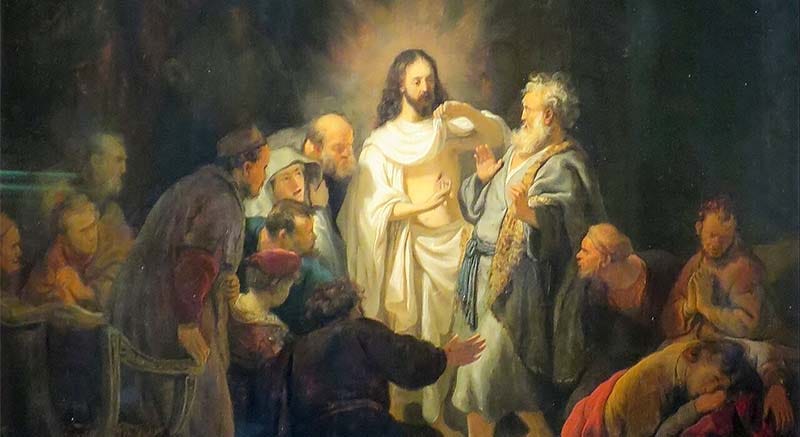
The Second Sunday in Easter is called both (in the Roman Rite of the Catholic Church) Divine Mercy Sunday and also (more broadly) Thomas Sunday, since the Gospel of John places Jesus’ appearance to doubting Thomas one week after the resurrection, and this episode from John 20 is read on this day in many traditions.
The incredulity of St. Thomas is the culmination of a theme running through the four Gospels beginning with the Holy Thursday accounts of the Last Supper and the agony of Jesus in the Garden of Gethsemane. Most strikingly, among key events attested in all four passion narratives are
Jesus’ prediction, at the Last Supper, of Peter’s three denials before the crowing of a cock;1
Peter’s protestations that he was ready to die rather than deny Jesus; and
the fulfillment of this prophecy during Jesus’ trials, followed by Peter’s tears of remorse.
All four Gospels also relate, in different ways, the fear and doubt of the rest of the disciples:
In Matthew and Mark, Jesus also predicted, in addition to Peter’s denials, that all of the Twelve would fall away, as happened in those Gospels in the Garden of Gethsemane, before his crucifixion and resurrection.
Luke and John, meanwhile, emphasize the fear and unbelief of the disciples after the crucifixion and resurrection, even in the face of reports of his return from death.2 Most memorably, in John’s Gospel, even when confronted with the testimony of the other ten apostles (less Judas Iscariot) that Jesus was risen, Thomas insisted that he would not believe until he himself had, not only seen the Lord with his own eyes, but manually inspected the marks made by the nails and the spear.3
For some readers, Peter’s meltdown, the fear and doubt of the others, and especially Thomas’s disbelief to the bitter end may seem perplexing, even perverse. After all, hadn’t the disciples already witnessed ample evidence of Jesus’ power, including power over death? And hadn’t he repeatedly predicted exactly what occurred: his arrest and execution, followed by his resurrection?
To the first point, all four Gospels relate that the Twelve had seen innumerable displays of Jesus demonstrating power over disease and disability, over the natural world, over the uncanny powers of darkness, and even over death itself. Before their eyes, Jesus fed thousands with a few loaves of bread and a couple of fish. In John as well as Matthew and Mark, the disciples witnessed Jesus walking on water; in Matthew, Peter himself briefly shared in this impossible moment. In the Synoptics, Peter, James, and John saw Jesus shining like the sun in the heavenly presence of Moses and Elijah. In all four Gospels, he raised the dead: in the Synoptics, the young daughter of Jairus (and, in Luke, the son of the widow at Nain); in John, Lazarus, four days dead and buried. They knew what he was capable of.
To the second point, all four Gospels depict Jesus, speaking to the disciples, repeatedly predicting his coming passion, execution, and resurrection. In the Synoptics he seems quite explicit about this: “The Son of Man is to be betrayed into human hands, and they will kill him, and three days after being killed, he will rise again” (Mark 9:31).4 The predictions in John are more oblique, but, among other things, he says, “I lay down my life in order to take it up again.… I have power to lay it down, and I have power to take it up again” (John 10:17–18).5 John also echoes Matthew in having Jesus explicitly connect the anointing at Bethany with his “burial,” adding, “The poor you will always have, but you will not always have me” (John 12:7–8; cf. Matthew 26:11–12).
Given this, it may seem hard to understand why Jesus’ arrest and crucifixion would be quite so terrifying and demoralizing to the Twelve, and his resurrection so unexpected and hard to accept. Why weren’t they expecting it? Or, at least, why weren’t they better prepared when they found it happening?
You had to be there
Something that must constantly be kept in mind as we read the Gospels is that the story as we read it, and the events for those living through them, are two very different things. C.S. Lewis once pointed out that something similar is true of the Old Testament in its original context and in a post–New Testament context, and noted how older Christian writers often failed to appreciate this point:
Our ancestors seem to have read the Psalms and the rest of the Old Testament under the impression that the authors wrote with a pretty full understanding of Christian Theology; the main difference being that the Incarnation, which for us is something recorded, was for them something predicted.6
As far as we know, no Old Testament writer, nor any Jew in Jesus’ day, had any notion of the invisible and unimaginable God becoming a human being, much less being crucified and raised from the dead. What hopes or expectations of a coming “messiah” existed were far more vague, shadowy and diverse than is widely imagined today; indeed, messianism played a far smaller role in Second Temple era Jewish thought than readers of the Gospels might guess.
More important than “the Messiah” in Jewish thought at this time was the idea of the “kingdom of God.”7 According to one version of this idea, Israel’s God would one day would soon reassert his dominion over all the earth and all mankind, bringing the world to judgment in an apocalyptic upheaval or cosmic transformation. Israel would be liberated from the tyranny of foreign powers, and all the nations (goyim) would bend the knee to Israel’s God and turn to Israel to learn true wisdom and knowledge of God and of his holy law.
In this “kingdom of God,” it was reasonable to think that a human king—a royal Davidic “Messiah,” or anointed/chosen one—would exercise dominion on God’s behalf. Likely enough this figure would also be a military leader who would play a key role in defeating God’s enemies, i.e., foreign powers, especially (at that time) the Romans.
But this apocalyptic Davidic Messiah was a figure of limited importance, at least according to some Jewish sources which suppose him to be under the supervision and instruction of the priests who mediate God’s law to him. Other traditions foresee two messiahs: a royal, Davidic Messiah of Israel and a priestly, Aaronic figure sometimes called the Prince of the Congregation. (Sometimes there was also a third figure, an eschatological prophet.)
The roles or identities of the royal Messiah of Israel and the priestly Prince of the Congregation are not always distinct; it may be that some had a notion of a chosen one who would be both priest and king. (I am unaware of any evidence that anyone foresaw a messiah who was at once priest, prophet and king—that triad seems to be of Christian origin—to say nothing of God in human flesh.)
At any rate, the idea of the kingdom of God was primary, and the royal Messiah was significantly an implication or consequence of it. On a side note, where Mark and Luke report Jesus (and John the Baptist before him) proclaiming the coming “kingdom of God,” Matthew’s Gospel often gives the reverent circumlocution “kingdom of heaven” so as not to overuse the divine Name, but this means the same thing. The “kingdom of heaven” in Matthew is not heaven itself as we think of it, but heaven’s reign on earth (“as it is in heaven”).
Thus, when John the Baptist began announcing the coming of the kingdom of God, and when Jesus subsequently took up this theme, it would have been understood by many if not all that they were announcing the imminent liberation of Israel from Roman tyranny—and this would widely have been understood, certainly by the Romans, as a heralding of insurrection and revolutionary war.
This is plausibly one reason that Jesus was so secretive about his messianic status, why he bound others to secrecy:8 A self-proclaimed Messiah was likely to wind up on a Roman cross—a means of execution reserved for certain particularly grave offenses including insurrection. (The “bandits” with whom Jesus was crucified were probably implicated in outlaw revolutionary activity.)
A crucified messiah was thus a reliably debunked, falsified messiah—and there had been any number of potential messiahs whom the Romans had crucified or otherwise killed, along with much larger numbers of followers. (This is one reason historians widely consider Jesus’ crucifixion to be among the most historically certain of his biographical details: It’s too humiliating and self-defeating to have been invented.)
The Gospels indicate that Jesus went to some trouble not to get arrested prematurely, often keeping his movements secret. (Note the precautions he took even during what we now call Holy Week, for instance not even telling his own disciples where they would celebrate the Passover, but sending two of them to meet a secret supporter, identified by a prearranged sign, who would lead them to the upper room [Mark 14:12–16]. This may well be because Jesus knew that if the location were known in advance—even among his disciples, including the one who would betray him—it would not long remain a secret from his enemies, and he would be arrested before celebrating that paschal meal with his disciples.)
These ideas about the kingdom of God and the Messiah are in evidence in the Gospels among Jesus’ followers, including the Twelve. The one thing that their Messianic expectations would not lead them to expect was for Jesus to be arrested, tried and executed. Nor would it lead them to expect resurrection from the dead. Resurrection, where it was believed in at all, was a mysterious, eschatological hope with no particular connection to the Messiah.
Jesus’ baffling language
The complicating factor, of course, is that the Gospels indicate that Jesus had told them, repeatedly and plainly (at least in the Synoptics), that all of this would happen—and that he would rise from the dead. But Mark’s Gospel indicates that what seems plain to us was anything but plain to them:
As they were coming down the mountain, he ordered them to tell no one about what they had seen, until after the Son of Man had risen from the dead. So they kept the matter to themselves, questioning what this rising from the dead could mean. (Mark 9:9–10)
He was teaching his disciples, saying to them, “The Son of man will be delivered into the hands of men, and they will kill him; and when he is killed, after three days he will rise.” But they did not understand the saying, and they were afraid to ask him. (Mark 9:31–32)
Here’s the thing I think Christians reading the scriptures today easily overlook: Jesus used a lot of arresting, mysterious, over-the-top language, a great deal of which apparently did not really mean the surface-level meaning of the words. Severing your hand and plucking out your eye; hating father and mother and your own life; letting the dead bury the dead; rebuilding the Temple in three days; eating his flesh and drinking his blood: it was often pretty impenetrable.
On one notable occasion, Jesus upbraided the disciples for taking his language too literally. When he warned them about “the leaven” or “the yeast” of the Pharisees, they thought this must have something to do with the awkward reality that they had forgotten to bring bread. “Why are you talking about having no bread?” Jesus asked them, reminding them of his history of feeding multitudes with scraps. Matthew reports that he added, “How is it that you fail to perceive that I did not speak about bread?”—and then they understood that by “leaven” he really meant the Pharisees’ teaching (Matthew 16:6–12; cf. Mark 8:14–21, Luke 8:12).
In the Synoptics, after predicting his passion for the first time following Peter’s confession of Jesus as the Messiah, Jesus went on to say, “If anyone would come after me, let them deny themselves and take up their cross [daily] and follow me” (Matthew 16:24, Mark 8:34, Luke 9:23). Literally carrying actual crosses did not in fact seem to be on the agenda for Jesus’ disciples. It could thus seem reasonable to suppose that the business of the Son of Man suffering and being killed also was not a thing that would literally happen.
That’s not all. In Matthew and Mark, after Jesus’ first prediction of his coming passion, Peter’s blinkered response (“God forbid it, Lord! This must never happen to you!”) was met with a stunning rebuke from Jesus—yet Jesus also said, “You are setting your mind not on divine things but on human things.” Might this not have sounded something like Jesus’ response to the misunderstanding about the “leaven” of the Pharisees? Perhaps Peter’s error had been to take Jesus as speaking about mortal, physical suffering and death, rather than some mysterious, spiritual reality. The disciples’ confusion is more understandable than it might seem at first to Christian readers.
Another failed messiah?
As late as Jesus’ arrest in Gethsemane, Peter still expected to fight with the sword for Jesus rather than watch him be arrested and crucified. Surely the time for some great revelation of Jesus’ power over God’s enemies was at hand. Peter had been there on the mountain when Jesus was transfigured in glory. Perhaps he would now be transfigured again, would become the glorious “Son of Man” described in Daniel 7, riding clouds of heavenly glory and claiming dominion over all nations and peoples, beginning with those who foolishly thought they could arrest him.
Imagine Peter’s cognitive dissonance when Jesus himself not only told him not to resist, but allowed himself to be taken away. What followed must have been a descent into unthinkable horror. Jesus, the wonder-working prophet, the expeller of demons, the one Peter had dared to pronounce the Messiah—this Jesus was suddenly a helpless victim in the hands of Israel’s great adversary: the very image of another failed messiah. All their hopes were turning out like those of the followers of all the other would-be messiahs who had ended in shame and failure on Roman crosses. Instead of reigning at his side, the Twelve themselves might be crucified with him, and that would be the ignominious end of the story.
What about the divine power they had unquestionably seen in Jesus? Well, what about it? Does God always do what people expect him to? What he did yesterday, can we count on him to do tomorrow? Consider: For a time God had seemed to bless the Maccabee revolt against the Seleucid Empire and the Hasmonean dynasty … yet the dynasty ultimately succumbed to Roman conquest. King Josiah was as righteous a reformer king as could be wished, and God had promised to reward righteousness in the sons of David, but Jerusalem fell to the Babylonians and the Babylonian exile followed. The Israelites carried the ark of the covenant from Eben-Ezer into battle against the Philistines, yet they were routed and the Philistines captured the ark. What if God was with Jesus in the early days in Galilee and in his prior action in Judea, but for his own inscrutable reasons had now abandoned him?
The bottom line is that what happened on Thursday and Friday of what we now call Holy Week looked unmistakably like defeat, not victory: and nothing Jesus had said or done earlier necessarily prepared his disciples to see it as anything else. The words of Cleopas and his companion on the Emmaus road express it well: “We had hoped that he was the one to redeem Israel” (Luke 24:21). It had looked like Jesus was the Messiah—but it now appeared, rather obviously, that he was not.
The incredulity of Thomas
The foregoing offers, I hope, critical context for the flight of the disciples in Gethsemane, for Peter’s denials, and for initial doubt and fear regarding early reports of the empty tomb and the first rumors that he was alive. The incredulity of St. Thomas is the last and most striking example of this theme, even if this case offers an additional level of difficulty: With the other ten apostles all reporting Jesus alive, why would Thomas be so resistant?
Here, perhaps, we meet the limits of what we can plausibly reconstruct with any specificity. John’s Gospel offers no insight how Thomas in particular, starting with the understandable fear and disbelief of the others, would have skeptically interpreted their claims to have experienced Jesus alive.
What we can reasonably suppose is that, like the others, Thomas had some kind of real, but deficient, belief in Jesus. Jesus attests this imperfect faith in the Synoptics when he frequently criticizes the Twelve for their deficient faith, and in John when he says to Philip, “Have I been with you so long, and yet you do not know me?” (John 14:9). This deficient faith had been shattered by Jesus’ arrest and crucifixion.
The resurrection offered an invitation to a new and higher sort of faith. Yet, if you have ever experienced a crisis or loss of deficient faith, and still more if you have since found your way back to a new and deeper experience of faith, you may be able to appreciate how an invitation to a higher or truer sort of faith may appear at first to the disillusioned as a mere return to the earlier, imperfect faith that you have found to be inadequate. Once bitten, twice shy, and all that.
To Thomas, then, the other disciples’ claims to have experienced Jesus alive may have seemed like desperate clinging to the now-shattered image of Jesus the hope of typical messianic belief—no other image as yet being in view. Thomas now knew what Jesus was not; what he was and is had not yet begun to dawn on him.
None of this is to excuse Thomas, Peter, or the others for their deficient faith. Jesus rebuking them means they could have and should have done better. But their state of mind is far more imaginable and understandable than it might seem to Christian readers on a superficial reading of the Gospels, and we are fooling ourselves if we feel sure that we would have done any better.
Mark specifies the cock crowing twice both in the prediction and in the fulfillment.
Matthew and Mark offer hints of this post-resurrection doubt and fear. The original text of Mark (in the oldest and best manuscripts) ends with the fear and silence of the women who discovered the empty tomb and were heralded by the angel (Mark 16:8). And Matthew tersely reports that when the eleven saw the resurrected Jesus in Galilee on the mountain, “they worshiped him, but some doubted” (Matthew 28:17).
In spite of Thomas’s words, and in spite of Jesus’ invitation to Thomas on the following Sunday to manually inspect the marks of his passion, it seems that (a long iconographic tradition and the speculations of spiritual writers to the contrary notwithstanding) Thomas found the mere sight and sound of Jesus’ presence persuasive enough, and did not require tactile confirmation. Not only does the Gospel not narrate Thomas taking Jesus up on his offer, Jesus’ reply to Thomas is precisely “Have you believed because you have seen [not ‘touched’] me? Blessed are those who have not seen and yet have come to believe” (John 20:28). This is one reason I chose Rembrandt rather than, say, Caravaggio (or many, many others) to open this post, since there is no actual probing of the Lord’s wounds by Thomas in this depiction!
The predictions of Jesus’ passion in John are more oblique. He speaks about being “lifted up” like the bronze serpent (John 3:14; cf. John 8:28, 12:32; in 12:33 John tells us, though it may not have been clear at the time, that “He said this to show by what death he was to die”). As in Matthew, John has Jesus mention his “burial” in connection with the anointing,
Some critical scholars may propose that the less explicit predictions in John could represent an older strain of Jesus tradition than the more explicit Synoptic predictions, and might be more authentic to Jesus’ ipsissima verba. Without prejudice to this question one way or the other, in this post my concern is with the Gospel texts as we have them. Those who don’t accept the fundamental historical value of the Gospels may choose to regard this inquiry as a question about “Bible characters” more than historical persons; that question is beyond the scope of my comments here.
C.S. Lewis, Reflections on the Psalms (Houghton Mifflin, 2020), 34.
For the following paragraphs, see Kenneth Pomykala, “Messianism,” and Dale C. Allison, “Kingdom of God,” in The Eerdmans Dictionary of Early Judaism, edited by John J. Collins and Daniel C. Harlow (Wm. B Eerdsmans, 2010).
The theme of the “Messianic Secret” was originally highlighed by William Wrede, who posited that it was not historical, but an invention of the author of Mark to explain the dearth of direct messianic claims in Jesus’ teaching. Later scholars, however, have pointed out that Jesus’ wish for secrecy on this point makes historical sense given preexisting messianic expectations and the complications and dangers inherent in a public claim of messianic identity.
Bit of a tangent here, but re: "Note the precautions he took even during what we now call Holy Week, for instance not even telling his own disciples where they would celebrate the Passover, but sending two of them to meet a secret supporter..."
What do you make of the fact that the Last Supper is *not* a Passover meal in John's gospel, which also does not have the story about the meeting with the secret supporter? Many people think John's chronology is more accurate (partly because there is no record of lamb being served at the Last Supper, and partly because the ancient Church used leavened bread -- not unleavened bread -- in the Eucharist, which is a practice that the Eastern churches still follow), but if it is, would there still have been a need for a meeting with a secret supporter?
(My provisional answer is that Jesus might have needed to keep the dinner secret even if it *wasn't* a Passover meal, because the dinner took place in Jerusalem, where all of Jesus' enemies were, and not in Bethany, which is where he normally spent the night during his pilgrimages to Jerusalem.) (For a moment I thought it might be possible that the Last Supper *didn't* take place in Jerusalem in John's gospel, but John 18:1 says Jesus "crossed the Kidron Valley" after the supper to go to the garden [of Gethsemane], so that's a pretty clear indication that the dinner *did* take place in Jerusalem, even in John's gospel.)
I’ve never understood how anyone could be surprised by the behaviour of the disciples, because I unfortunately find it pretty easy to empathise with panic, mistrust, pessimism and despair. It’s their post-Pentecost courage and unflagging faith that always strikes me as amazing and in need of the explanation that the Pentecost itself supplies.