

Converse vs. inverse
[a language PSA, and a little logic]


And now, a public service announcement for those who, like me, have long been dimly aware that the words converse and inverse are related but distinct terms, but haven’t been sure how to use them properly.
Here it is in a nutshell: For any conditional (if-then) statement,1 the converse is what you get if you flop the terms of the if-then clauses back to front. For “If A, then B,” the converse is “If B, then A.” Like so:
If it’s Saturday morning, we’re watching cartoons. → If we’re watching cartoons, it’s Saturday morning.
In this operation, positive or negative values flop with the terms; “If not A, then B” becomes “If B, then not A”; etc. Like so:
If it’s not raining, I take my bike to work. → If I take my bike to work, it’s not raining.
The inverse, on the other hand, is what you get if you keep the terms in the same order, but invert the positive or negative values of both terms. For “If A, then B,” the inverse is “If not A, then not B.” Likewise, for “If not A, then B,” the inverse is “If A, then not B”; etc. Like so:
If it’s Saturday morning, we’re watching cartoons. → If it’s not Saturday morning, we’re not watching cartoons.
If it’s not raining, I take my bike to work. → If it is raining, I don’t take my bike to work.
Let’s run through both terms again, side by side.
If you finished your supper, you get dessert.
Converse: If you get dessert, you finished your supper.
Inverse: If you didn’t finish your supper, you don’t get dessert.
If you live in a glass house, you shouldn’t throw stones.
Converse: If you shouldn’t throw stones, you live in a glass house.
Inverse: If you don’t live in a glass house, you should throw stones.
If the princess kissed the frog, he turns into a prince.
Converse: If the frog turns into a prince, the princess kissed him.
Inverse: If the princess didn’t kiss the frog, he doesn’t turn into a prince.
If you want to use the terms converse and inverse correctly, that’s all you need to know!2
A deeper dive
For those who want to dig a little deeper: You may have noticed that the truth (or falsehood) of the converse or inverse of a conditional statement does not follow from the truth (or falsehood) of the original statement. For example, it could be true that “If it’s Saturday morning, we’re watching cartoons,”3 but that doesn’t make it also true that if we’re watching cartoons, it’s Saturday morning. (We might watch cartoons at other times also.)4 And, while it’s true that people who live in glass houses shouldn’t throw stones, it doesn’t follow that people who don’t live in glass houses should throw stones!
One thing that does follow, for any conditional statement true or false, is that the converse and inverse are always either both true or both false; in fact, the converse and inverse of any conditional statement are two ways of saying the same thing.5 For example, suppose that I take my bike to work only when absence of rain converges with other favorable conditions (e.g., the temperature isn’t too cold; I don’t have other stops to make). In that case, the original statement “If it’s not raining, I take my bike” isn’t strictly true; just because it’s not raining doesn’t mean I necessarily take my bike. However, both the converse (“If I take my bike, it’s not raining”) and the inverse (“If it is raining, I don’t take my bike”) would still be true; in fact, they would be the same truth, expressed different ways.6
Likewise, we can accept the truth of the statement “If the princess kissed the frog, he turns into a prince” without necessarily accepting that if the frog turns into a prince, the princess kissed him (the converse), or that if the princess didn’t kiss the frog, he doesn’t turn into a prince (the inverse). For example, if the princess had other means at her disposal of breaking the spell, the converse and the inverse would both be false, despite the truth of the original statement.7
One more example, of Catholic interest: If would obviously be false to say “If Rome doesn’t teach it as dogma, it’s not true”: but orthodox Catholics affirm both the converse (If it’s not true, Rome doesn’t teach it as dogma) and the inverse (If Rome does teach it as dogma, it is true).
One more
Finally, some readers may want to bring up a not-so-secret third thing called the contrapositive—but if you’re dropping words like that, you probably already know all of this, don’t you?8 For the sake of completeness: The contrapositive is what you get when you do the converse and the inverse at the same time, both swapping the if-then terms and inverting the positive or negative values. So:
If it’s not raining, I take my bike to work.
Converse: If I take my bike to work, it’s not raining.
Inverse: If it is raining, I don’t take my bike to work.
Contrapositive: If I don’t take my bike to work, it is raining.
If the princess kissed the frog, he turns into a prince.
Converse: If the frog turns into a prince, the princess kissed him.
Inverse: If the princess didn’t kiss the frog, he didn’t turn into a prince.
Contrapositive: If the frog doesn’t turn into a prince, the princess didn’t kiss him.
If you’re a visual thinker like me, this image may (or may not!) help.
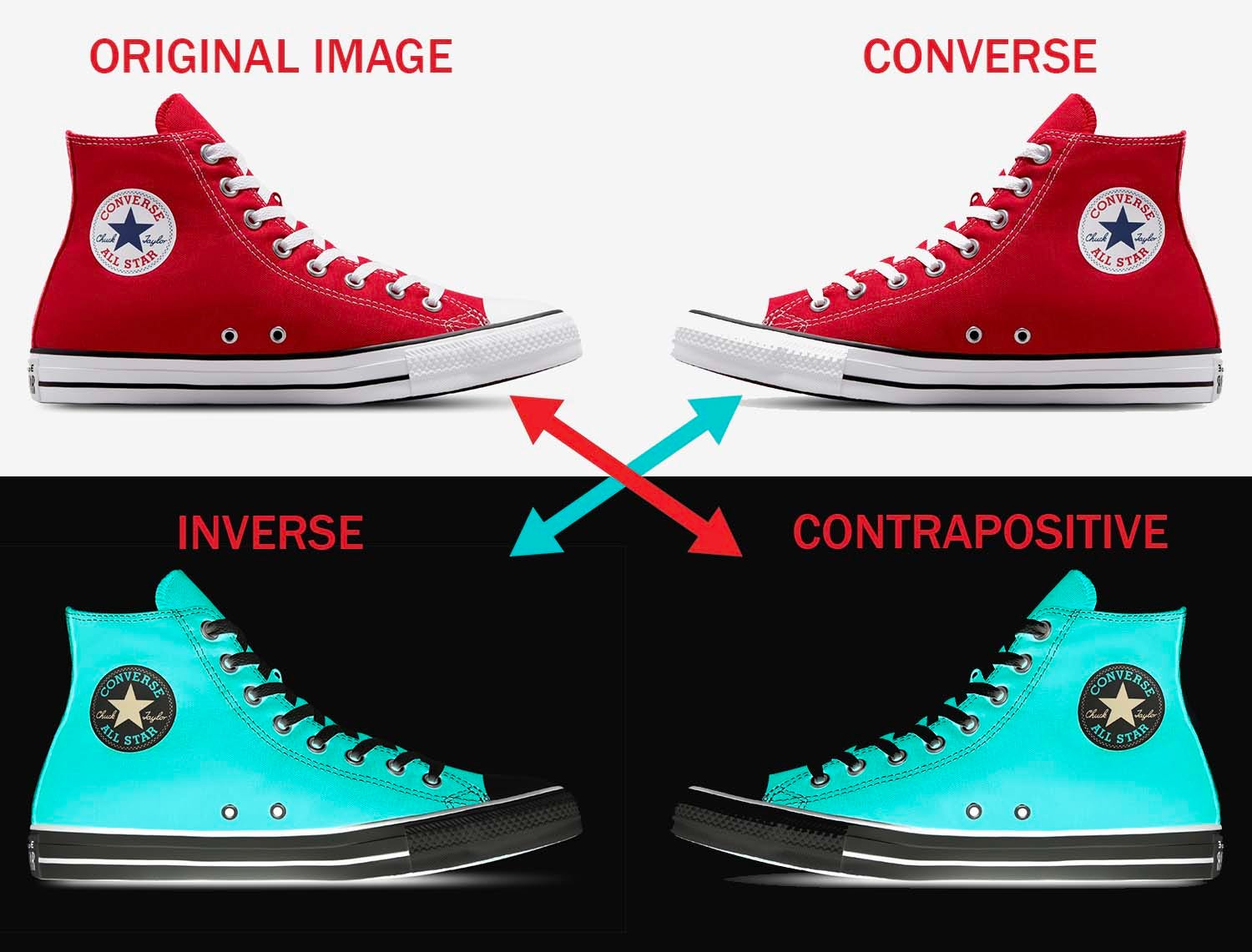
You see? The converse flops the if/then terms (with their positive or negative values) back to front (“If A, then not B” becomes “If not B, then A”); the inverse inverts the positive/negative values of the terms (“If A, then not B” becomes “If not A, then B”); the contrapositive both flops and inverts the terms (“If A, then not B” becomes “If B, then not A”). The diagonal arrows indicate equivalency: Just as the converse and the inverse of a given statement are equivalent, so the contrapositive is equivalent to the original statement; each pair is either both true or both false.9
Thus, “If the princess kissed the frog, he turns into a prince” and its contrapositive “If the frog doesn’t turn into a prince, the princess didn’t kiss him” are either both true or both false, and also the converse and the inverse (“If the frog turns into a prince, the princess kissed him” and “If the princess didn’t kiss the frog, he didn’t turn into a prince”) are both true or both false. But neither the truth nor the falsehood of either pair of statements tells you for sure the truth or falsehood of the other pair. They could all four be true, or all four be false, or one set could be true and the other false.
Now you know! Or maybe, you know, you don’t. Either way, I hope this was diverting!
Strictly speaking, converse and inverse are not used only with conditional if-then statements; they can also be used in categorical statements, such as “All men are mortals.” In ordinary speech, outside of formal logic contexts, there’s no reason for anyone to think about such things. (It’s pretty straightforward with the converse [“All mortals are men”], but it gets tricky with the inverse [“Some non-men are non-mortals”]. Again, no reason to go there in a language post!)
I wish I had a nice mnemonic to help you remember which is which! Even after I learned them, I still mixed up converse and inverse all the time, until one day they just stuck in my head. (If it helps you to think “The inverse inverts the positive/negative values,” that’s great, but “The converse flops the if/then terms back to front” you just have to get, so far as I can see.)
This is, in fact, true at the Grey Havens: If it’s Saturday morning, we’re watching cartoons. (This past Saturday we watched Looney Tunes and Avatar: The Last Airbender.)
This is also true at the Grey Havens. (Last week we watched The Incredibles during the week.)
Logically, then, the easiest way to state the difference between the converse and the inverse is that there is no difference; they’re one and the same! They are different semantically, though, and since here at Dailies & Sundays we care about language as well as logic, we’re going to press on.
This is all pretty much true for me. It has to be below 25° F (close to -4° C) to stop me from riding my bike to work, but I do have limits. On the other hand, I’ve been known to bike in a very light, brief rain, so the converse/inverse aren’t (or isn’t) 100 percent true either.
There are admittedly cases where the “truth” of statements of this kind can be a sort of moot point. For example, consider a scenario in which there is no dessert to be had no matter what. In that case, “If you’ve finished your supper, you’ll get dessert” would be manifestly false. But the inverse—“If you didn’t finish your supper, you won’t get dessert”—would not be manifestly false; it would be true, if trivially so, since the reality is that you won’t get dessert either way. What about the converse? “If you get dessert, you finished your supper”: This would be what is sometimes called vacuously true, or true in the sense that, although it doesn’t actually describe anything real, it doesn’t contradict reality either; there are no counter-examples, no one who got dessert without finishing their supper.
Like categorical converse and inverse; this is something else that no one has to worry about in ordinary English usage; it’s strictly a thing in formal logic.
And, of course, for any of these four statements, the other three can be redefined as the converse, the inverse, and the contrapositive, if you follow me. These four statements are like the sides of a rectangle; the opposite sides are always equal, and it doesn’t matter which of them you start with.
If it is raining, I don’t take my bike to work. (The original inverse)
Converse: If I don’t take my bike to work, it is raining. (The original contrapositive)
Inverse: If it’s not raining, I take my bike to work. (The original if-then statement)
Contrapositive: If I take my bike to work, it’s not raining. (The original converse)
Sheesh, and I thought *I* was a grammar-and-word nerd!
If I liked the column, then i get the sneakers, and if i don’t get the sneakers then i didn’t like the column?